
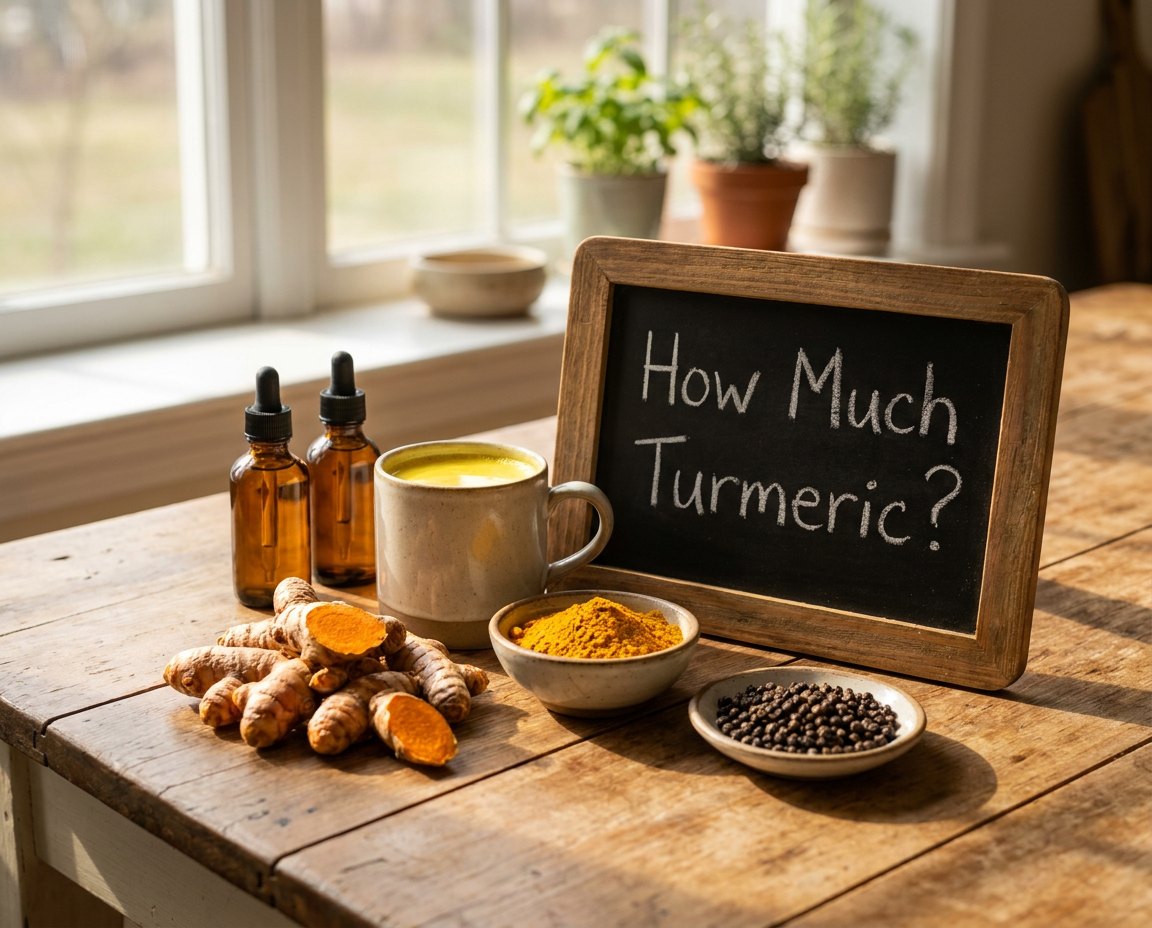
How much turmeric for inflammation? There is no official dose, but clinical studies on joint comfort have commonly used about 500 to 2,000 mg a day of turmeric extract or curcumin, usually for 4 to 12 weeks. Those are amounts researchers tested, and early results are encouraging. The label on your product and a quick chat with a professional are the best guides for you.
Turmeric is one of the most asked-about herbs at our Winston-Salem counter. Let’s walk through what the research says, how people take it, and how to pick the form that fits you.
What Is Turmeric, and What Is Curcumin?
Turmeric (Curcuma longa) is a relative of ginger grown mainly in India and Southeast Asia. The part we use is the underground stem, or rhizome, which is dried and ground into the bright yellow spice you know from curry. It has a long history in Ayurvedic and traditional Asian practices.
Curcumin is the best-known compound in turmeric and the one that gives it that golden color. Most research focuses on curcumin or on standardized extracts rich in curcuminoids, rather than on the kitchen spice. That matters, because a teaspoon of ground turmeric and a capsule of concentrated curcumin are very different things. When you read a study, always check whether it used whole turmeric, an extract, or isolated curcumin.
How Much Turmeric for Inflammation Have Studies Used?
A 2016 review of trials on curcuma products for knee osteoarthritis found daily amounts ranging from about 200 mg to 2,000 mg, taken for anywhere from 4 weeks to 8 months. Some trials measured the weight of the whole extract and others measured curcumin content, so the numbers are not directly comparable. The NIH LiverTox database notes that suggested daily amounts on products range from roughly 100 mg to over 1,000 mg depending on the formula.
We share these figures to help you read labels. The NIH’s National Center for Complementary and Integrative Health (NCCIH) points out that curcumin supplements differ in how much curcumin they actually contain, so the label on your product is your best guide.
Does Turmeric Work for Joints? What the Research Suggests
Turmeric for joints is where most of the human research lives. According to NCCIH, meta-analyses suggest oral turmeric or curcumin may help with knee pain, stiffness, and function, and the agency calls that initial evidence positive, with more research underway. The 2016 review reached a similar place, as most trials reported improvements compared with placebo.
Beyond joints, research is still growing. We think of turmeric as a traditional herb that may support everyday comfort for some people, with early studies that are encouraging. It has been part of Ayurvedic and traditional Asian practices for centuries, and it fits easily into a daily routine, from a mug of golden milk to a few drops of tincture.
Why Take Turmeric With Black Pepper?
Curcumin on its own is poorly absorbed. Much of it passes through the gut or is broken down quickly, which is one reason researchers have looked for ways to raise blood levels. The most famous pairing is turmeric with black pepper. In a small 1998 human study, adding 20 mg of piperine, the compound that gives black pepper its bite, to 2 grams of curcumin raised curcumin’s bioavailability by about 2,000 percent compared with curcumin alone.
NCCIH lists piperine as one way to improve absorption. In the kitchen, that is as simple as adding a pinch of black pepper to your curry, soup, or golden milk, a pairing cooks have enjoyed for generations. If you are considering a concentrated capsule with added piperine, a professional can help you choose the right one.
Turmeric Tincture vs Capsules: Which Form Fits You?
The turmeric tincture vs capsules question comes down to how you like to take your herbs. Capsules usually list a precise milligram amount, and many are standardized to a certain percentage of curcuminoids, which makes it easier to compare a product with what was used in a study. Some capsules also include piperine, so read the label carefully.
Tinctures are liquid extracts, usually made with alcohol, taken as drops in water or juice. Many people find them easy to swallow. A whole-root tincture reflects the root itself rather than isolated, concentrated curcumin. Whichever form you choose, sticking with one turmeric product at a time keeps your routine simple.
Good to Know About Turmeric
Turmeric has been a beloved kitchen spice for centuries, and NCCIH notes that typical oral forms are likely safe in recommended amounts for up to 2 or 3 months. If you are pregnant, nursing, taking medications, or have any concerns, you can talk with your healthcare provider or with Kayla, the herbalist behind House of Serenity, who works one-on-one with clients.
At a Glance: Turmeric
| Herb | Traditional use | Common forms | Good to know |
|---|---|---|---|
| Turmeric (Curcuma longa) | Everyday joint comfort, digestion, and wellness in Ayurvedic and Asian traditions | Spice, tea, golden milk, tinctures, capsules | Earthy and warm; pairs well with black pepper, ginger, and cinnamon |
| Black pepper (piperine) | Culinary spice often paired with turmeric | Ground pepper, added to some curcumin capsules | A pinch adds gentle heat to golden milk or curry |
Our House of Serenity Organic Turmeric Tincture
If you would like to add turmeric to your routine in liquid form, we carry the House of Serenity Organic Turmeric Tincture, made from pure organic turmeric root. It is a simple single-herb option for people who prefer drops over capsules.
You will also find turmeric among the featured herbs in the House of Serenity Brain Booster Tincture, alongside shankhpushpi, rosemary, ginkgo, gotu kola, and brahmi. If you already use one, our team is happy to help you plan how the two fit together. Curious about other herbs that pair well with a calmer daily routine? Our guide to top relaxing herbs is a good next read, and if you take blood pressure medication, our post on herbs to avoid with blood pressure medication is a helpful read too.
Where to Find Turmeric in Winston-Salem
Stop by The Leafy Source at 4838 Country Club Rd, Winston-Salem, NC 27104. Our team is happy to answer questions and show you the House of Serenity Organic Turmeric Tincture.
Frequently Asked Questions About Turmeric
How much turmeric should I take a day?
There is no official daily amount. Studies on joint comfort have commonly used about 500 to 2,000 mg a day of turmeric extract or curcumin, but products differ a lot in strength. Follow the label on the product you choose, and if you take medications or have any concerns, a quick chat with a professional can help you find what fits.
Does black pepper really help turmeric absorb?
Research suggests it does. In one small human study, 20 mg of piperine from black pepper raised curcumin’s bioavailability by about 2,000 percent. That is one reason many people add a pinch of black pepper to golden milk, curries, and soups. Some curcumin capsules also include piperine, so check the label to see what your product contains.
How long does it take for turmeric to work?
In the joint studies we reviewed, people took turmeric products for at least 4 weeks, and often 8 to 12 weeks, before researchers measured changes. Results varied from person to person, so consistency matters. Many people make turmeric part of a daily ritual, like a morning tincture or an evening cup of golden milk.
What is the best way to enjoy turmeric in food?
Turmeric shines in curries, soups, rice, scrambled eggs, and roasted vegetables. Golden milk, made by warming milk or a plant-based milk with turmeric, a pinch of black pepper, cinnamon, and a little honey, is a cozy favorite. Start with a small spoonful in your cooking, since its earthy flavor and bright color go a long way.
How should I store turmeric?
Keep ground turmeric and dried root in an airtight container away from heat, light, and moisture, such as a cool kitchen cabinet. That helps preserve its bright color and earthy aroma. Tinctures do best with the cap closed tightly and out of direct sunlight. If your spice has faded to a dull color or lost its scent, it is time for a fresh batch.
Sources
- NCCIH: Turmeric
- Perkins et al., Efficacy of Curcuma for Treatment of Osteoarthritis, J Evid Based Complementary Altern Med (PMC)
- NIH LiverTox: Turmeric
- Michigan Medicine Health Library: Turmeric
Before starting any new herbal product or wellness routine, consult with a qualified healthcare professional, especially if you are pregnant, nursing, taking medications, or managing a medical condition.